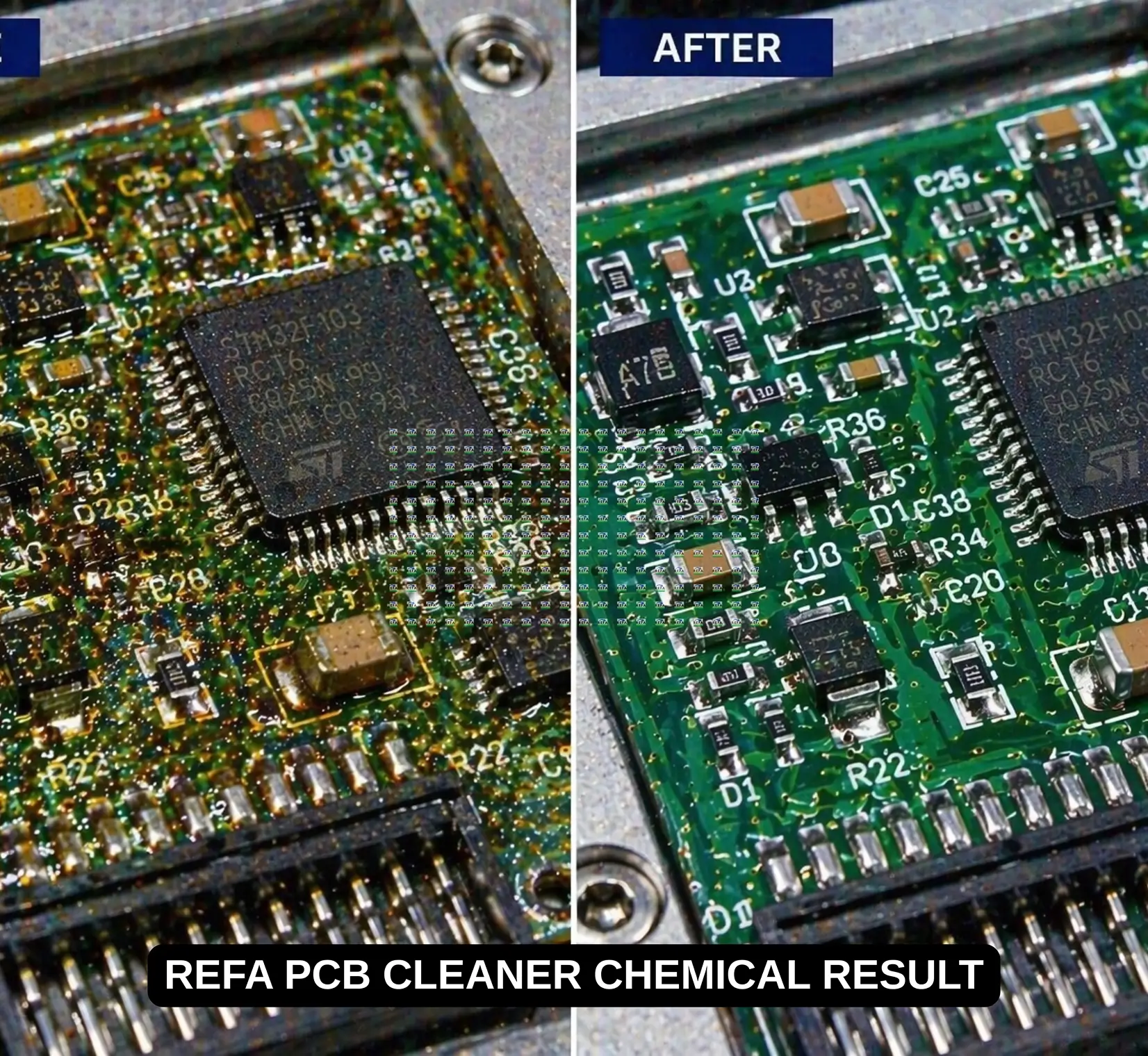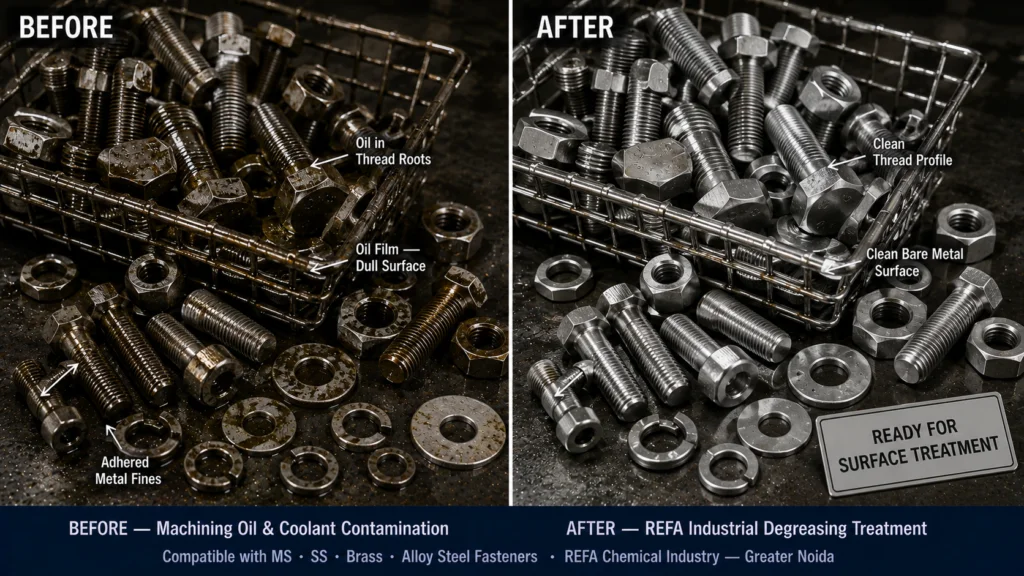
A machined automotive component can look perfectly clean and still contain enough contamination to cause problems during assembly or operation.
That is one of the challenges facing modern auto parts manufacturers.
A component may leave a CNC machine with an excellent dimensional finish. It may appear free from visible oil and grease. Yet fine metallic particles, machining fluid residues or contamination trapped inside small passages can remain on its surface.
In automotive manufacturing, these contaminants are not always cosmetic defects.
They can interfere with component assembly, affect coating adhesion, contribute to corrosion or create problems in systems where cleanliness is critical.
This is why precision cleaning has become an important part of automotive component manufacturing.
For businesses searching for precision cleaning chemicals for auto parts manufacturers, the real requirement is not simply a stronger degreaser. It is a cleaning formulation compatible with the component, contamination, washing equipment and required cleanliness level.
REFA Chemical Industries Pvt. Ltd., based in Greater Noida, India, develops and manufactures water-based industrial metal cleaning and degreasing chemicals for automotive, automotive HVAC and other engineering applications.
Understanding the difference between ordinary cleaning and precision cleaning is the first step towards choosing the right chemical.
What Is Precision Cleaning in Automotive Component Manufacturing?
Precision cleaning is a controlled process intended to remove contaminants from manufactured components to a specified cleanliness requirement.
Unlike general-purpose degreasing, precision cleaning may involve controlling both chemical residues and particulate contamination.
The contaminants can include:
- Machining oils and cutting fluid residues
- Metallic chips and fine particles
- Grease and processing lubricants
- Carbonaceous deposits
- Polishing and buffing compounds
- Dust and handling contamination
- Residues from previous manufacturing operations
The acceptable contamination level depends on the component and its intended use.
For example, a fabricated steel bracket may have different cleanliness requirements from a hydraulic valve component containing narrow passages.
Both components need cleaning, but they do not necessarily need the same cleaning process.
Precision cleaning therefore involves more than selecting a chemical. It requires matching the chemistry, equipment and process conditions to a defined cleanliness objective.
Why Precision Cleaning Matters for Auto Parts Manufacturers
Automotive manufacturing involves components that must operate reliably under demanding conditions.
Even small amounts of unwanted contamination can create difficulties in certain applications.
1. Protecting Component Functionality
Metallic particles remaining inside precision-machined components can interfere with moving parts, seals and sensitive assemblies.
This is particularly relevant in hydraulic, fluid-handling and other systems where particles may circulate or become trapped.
2. Supporting Reliable Assembly
Oil and grease residues can interfere with certain joining, bonding and sealing operations.
Cleaning requirements should therefore consider what happens to the component after washing.
3. Improving Surface Preparation
Before painting, powder coating or other finishing processes, the metal surface generally needs to be adequately prepared.
Residual oil, grease or cleaning chemistry may contribute to coating defects or poor adhesion.
4. Reducing Corrosion Risks
Cleaning and drying must be properly controlled, particularly for corrosion-sensitive metals.
An unsuitable cleaner, inadequate rinsing or residual moisture may contribute to staining or corrosion during storage.
5. Meeting Customer-Specific Cleanliness Requirements
Automotive OEMs and component customers may specify cleanliness limits for certain parts.
These requirements can involve particulate contamination, residual oils or other characteristics depending on the component.
Manufacturers must evaluate the complete cleaning process against the applicable customer specification.
A component is not necessarily clean because it looks clean. It is clean when it meets the cleanliness requirements established for its application.
Precision Cleaning vs Conventional Industrial Degreasing
Although the terms are sometimes used interchangeably, conventional degreasing and precision cleaning are not always the same.
| Parameter | Conventional Degreasing | Precision Cleaning |
|---|---|---|
| Main objective | Remove oils, grease and visible contamination | Achieve defined component cleanliness |
| Contamination focus | Primarily oil, grease and general residues | Oils, residues and potentially fine particles |
| Process control | Depends on application | Often requires tighter process control |
| Inspection | May include visual or surface checks | May include defined analytical cleanliness testing |
| Typical applications | General metal cleaning and pretreatment | Sensitive automotive and precision-engineered components |
The distinction is not absolute. A well-controlled degreasing process may also be part of a precision cleaning system.
What matters is the required outcome.
Automotive Components That May Require Precision Cleaning
Different automotive components have different contamination risks.
Aluminium Die-Cast and Machined Components
Aluminium components are widely used in automotive housings, brackets, compressor parts and other engineered assemblies.
After machining, they may contain cutting oils, fine metallic particles and other residues.
Cleaning chemistry must remove contamination without causing unacceptable staining, etching or surface damage.
Because aluminium alloys differ in chemical sensitivity, compatibility testing is important.
Automotive HVAC Components
Automotive heating, ventilation and air-conditioning systems contain components that may require controlled cleanliness during manufacturing and assembly.
Depending on the component, unwanted particles or residues can affect subsequent operations or system performance.
Cleaning processes should account for the materials involved, internal geometries and applicable customer requirements.
Hydraulic and Fluid-Handling Components
Hydraulic components, valves and other fluid-handling parts may be particularly sensitive to particulate contamination.
Fine particles remaining inside passages or cavities can be difficult to remove through ordinary washing.
The cleaning process may require appropriate fluid movement, filtration, rinsing and cleanliness verification.
Mild Steel and Cast Iron Components
Steel and cast iron components may carry machining oils, metallic fines and other processing residues.
The cleaning chemical must provide effective contamination removal while controlling corrosion risks during and after cleaning.
Rinsing, drying and any required temporary rust protection are important considerations.
Stainless Steel Components
Stainless steel is generally corrosion-resistant, but it is not immune to surface contamination or compatibility problems.
Cleaning chemistry must be selected according to the grade, contamination and required finish.
Multi-Metal Assemblies
Some automotive assemblies contain more than one metal.
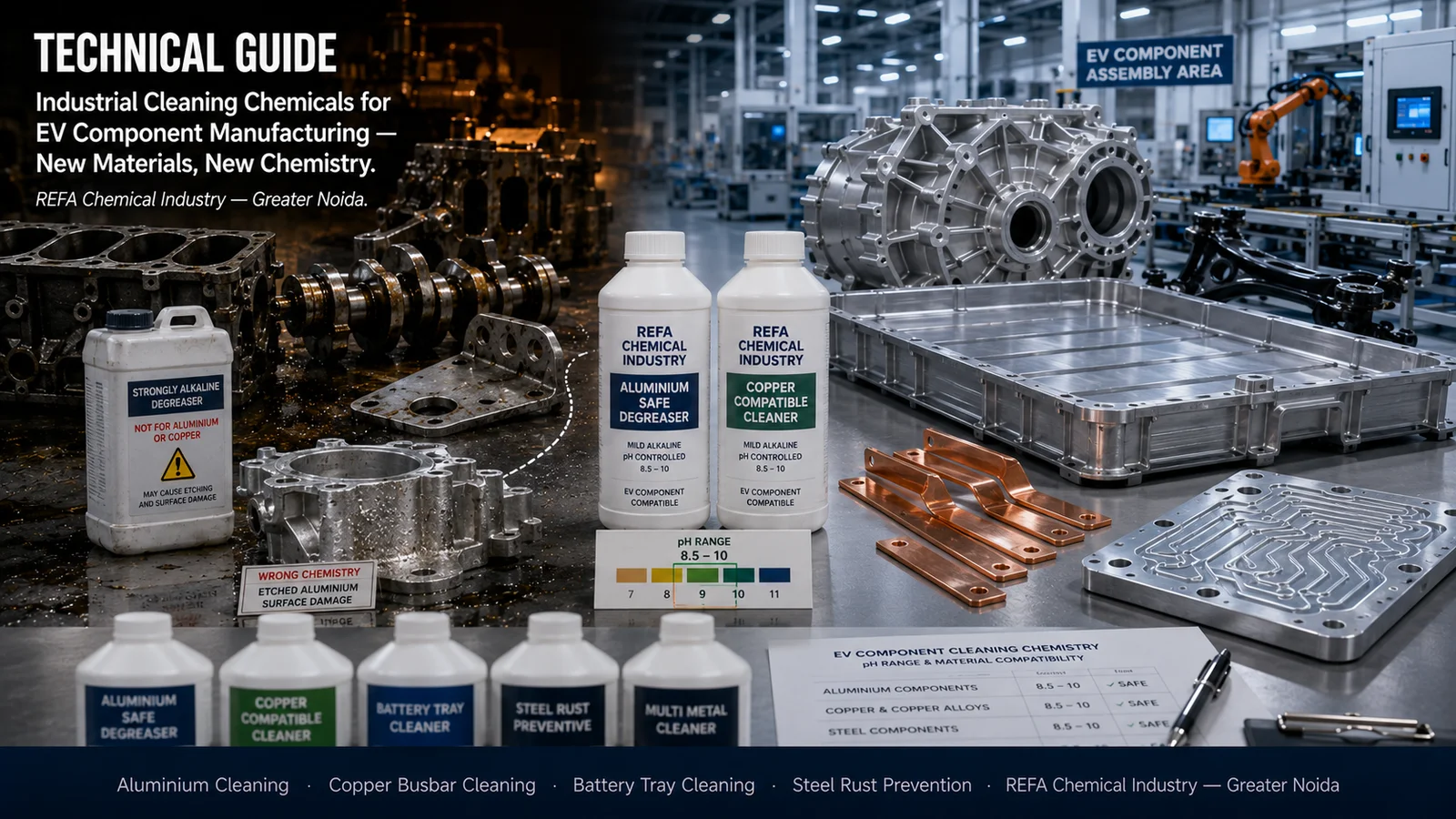
A chemical suitable for one substrate may adversely affect another.
Multi-metal cleaning therefore requires careful evaluation of the complete assembly, including any seals, coatings or non-metallic materials.
Types of Precision Cleaning Chemicals Used in Automotive Manufacturing
There is no single chemical suitable for every precision cleaning application.
The appropriate formulation depends on the contamination, material and cleaning method.
Alkaline Precision Cleaning Chemicals
Alkaline formulations are widely used in industrial metal cleaning applications.
They may contain combinations of surfactants, builders, corrosion inhibitors and other functional ingredients.
Their performance depends on the formulation and operating conditions.
Alkaline cleaners can be effective against many oils and greases, but metal compatibility must be considered, particularly for aluminium and other sensitive materials.
Neutral and Mild Cleaning Formulations
Some applications require comparatively mild cleaning conditions because of sensitive substrates, coatings or assemblies.
Neutral or mildly formulated cleaners may be considered where appropriate, provided they achieve the required contamination removal.
A neutral pH alone does not guarantee material compatibility or cleaning performance.
Acidic Cleaning Chemicals
Acidic formulations are used in selected metal treatment applications, including removal of certain oxides or inorganic deposits.
They are not interchangeable with ordinary oil degreasers.
Their suitability depends on the metal, contamination and intended process.
Water-Based Precision Cleaning Chemicals
Water-based formulations use water as the primary carrier and may contain surfactants, builders, inhibitors and other ingredients.
For suitable applications, they can provide an alternative to certain solvent-based cleaning processes.
However, water-based does not automatically mean non-hazardous or environmentally harmless.
Product-specific safety documentation and operating requirements must be considered.
How Precision Cleaning Chemicals Work With Different Cleaning Machines
The cleaning chemical and equipment should be evaluated together.
A formulation that performs well in an immersion tank may not be appropriate for a high-pressure spray washer or ultrasonic cleaning system.
Ultrasonic Cleaning
Ultrasonic cleaning uses high-frequency sound energy transmitted through a liquid to generate cavitation effects that assist in removing contamination.
It can be useful for certain complex geometries and difficult-to-access surfaces.
Typical considerations include:
- Ultrasonic frequency and power
- Tank design and component positioning
- Cleaning solution concentration
- Temperature and exposure time
- Contamination loading
- Rinsing and drying
- Material compatibility
The chemical must be suitable for ultrasonic operation, including its foaming characteristics and interaction with the equipment.
Spray Cleaning
Spray washing machines use pressurised cleaning solution directed towards components.
Spray cleaning may be suitable for production lines requiring controlled, repeatable cleaning.
The chemical should be selected for the spray system’s operating conditions, particularly foam control, contamination removal and rinsability.
Immersion Cleaning
In immersion cleaning, components are submerged in a chemical solution for a defined period.
Agitation, temperature and chemical concentration may influence cleaning performance.
Immersion cleaning can be appropriate for various component types, but complex internal passages may require additional process considerations.
Multi-Stage Cleaning Systems
Some automotive cleaning lines include multiple stages, such as:
- Pre-cleaning
- Main chemical cleaning
- Intermediate rinsing
- Final rinsing
- Drying
- Cleanliness inspection, where required
The exact sequence depends on the component and quality requirements.
Adding more stages does not automatically guarantee better cleanliness. Each stage must serve a defined purpose.
How to Select the Right Precision Cleaning Chemical
Choosing a precision cleaning chemical based only on price or a generic product description can lead to unnecessary production problems.
The selection process should begin with the actual manufacturing application.
Identify the Component Material
Determine whether the component is aluminium, steel, cast iron, stainless steel, copper, brass or a multi-material assembly.
Different substrates may require different chemical formulations.
Understand the Contamination
Machining oil, grease, polishing compound and metallic particles are different contamination types.
A formulation effective against one contaminant may not be sufficient for another.
Evaluate the Cleaning Equipment
The chemical must be compatible with the cleaning machine, including its operating temperature, agitation, spray pressure or ultrasonic conditions.
Define the Required Cleanliness
The manufacturer should establish what level of cleanliness is necessary.
This may involve visual requirements, residual oil limits, particulate contamination limits or other customer-specific criteria.
Consider Rinsing and Drying
A chemical that removes oil effectively but leaves unacceptable residues after rinsing may not be suitable for the process.
Drying is equally important, particularly for corrosion-sensitive components.
Compare Total Operating Costs
The price per kilogram is only one part of the cost.
A more meaningful comparison considers working concentration, chemical consumption, bath life, water and energy usage, waste generation and rework.
The objective is to achieve the required cleanliness at a sustainable cost per acceptable component.
Understanding Millipore Testing, ISO 16232 and VDA 19.1
In automotive manufacturing, component cleanliness may be evaluated using particulate contamination testing.
The term Millipore test is commonly used in industry to describe membrane filtration-based cleanliness testing, although the actual procedure and acceptance criteria must be specified.
In a typical extraction-and-filtration approach, particles are removed from a component using a defined extraction method.
The extracted contamination is then collected and analysed according to the applicable procedure.
Depending on the method, evaluation may include particle mass, size, count and classification.
Two important technical references are:
ISO 16232 — Road vehicles — Cleanliness of components and systems
This standard provides methods associated with assessing particulate contamination of automotive components and systems.
VDA 19.1 — Inspection of Technical Cleanliness
This guidance is used in the automotive industry for technical cleanliness inspection and evaluation.
Neither reference establishes one universal cleanliness limit suitable for every automotive component.
The required acceptance criteria must be determined by the relevant component specification or customer requirement.
A cleaning chemical should therefore be evaluated as part of the complete process rather than assumed to guarantee compliance with a cleanliness standard.
Five Common Precision Cleaning Mistakes in Auto Parts Manufacturing
Mistake 1: Selecting a Cleaner Based Only on Price
A cheaper chemical may require a higher concentration, frequent bath replacement or additional cleaning time.
The true cost should be measured against acceptable cleaned components.
Mistake 2: Increasing Chemical Concentration Without Investigating the Problem
When cleaning performance declines, operators may increase chemical concentration.
However, the actual problem could be excessive contamination loading, poor filtration, unsuitable temperature, inadequate agitation or ineffective rinsing.
More chemical is not always the solution.
Mistake 3: Ignoring Rinsing and Drying
Cleaning is only one stage of the process.
Residual cleaner, contaminated rinse water or retained moisture can create problems after washing.
Mistake 4: Using One Chemical for Every Metal
A formulation suitable for mild steel may not be appropriate for aluminium, copper or multi-metal assemblies.
Material compatibility should be verified.
Mistake 5: Assuming Visual Cleanliness Proves Technical Cleanliness
A visually clean component can still contain particles or residues.
Where cleanliness is critical, the required inspection method must be used.
REFA Chemical Industries: Precision Cleaning Chemicals for Automotive Component Manufacturers
REFA Chemical Industries Pvt. Ltd. manufactures water-based industrial cleaning and degreasing chemicals from its facility in Greater Noida, Uttar Pradesh, India.
The company’s industrial chemical portfolio supports applications involving aluminium, mild steel, cast iron, stainless steel, copper, brass and other compatible materials.
REFA’s cleaning chemistry covers industrial degreasing, precision cleaning, ultrasonic cleaning, spray washing and selected application-specific processes.
Its wider product portfolio also includes metal surface preparation, pretreatment, corrosion prevention and metalworking chemicals.
This broader understanding of industrial processes can be useful because cleaning performance is often influenced by earlier manufacturing operations.
For example, the type of cutting fluid used during machining may influence the cleaning chemistry required afterward.
Similarly, a component destined for painting or coating may have different cleaning requirements from a component going directly into mechanical assembly.
REFA’s approach is to understand the component and manufacturing process before recommending a chemical for evaluation.
The appropriate formulation and operating parameters should be confirmed through technical trials and customer-specific validation.
What Information Should You Share With a Precision Cleaning Chemical Manufacturer?
When contacting a chemical manufacturer, providing accurate application details can make product selection faster and more meaningful.
Useful information includes:
- Component name and material
- Manufacturing process before cleaning
- Type of contamination
- Existing cleaning chemical, if any
- Cleaning equipment and capacity
- Operating temperature and cleaning time
- Current chemical concentration
- Required cleanliness specification
- Rinsing and drying process
- Approximate monthly chemical consumption
- Problems with the existing cleaning process
Where possible, photographs of the component and details of the current process can also help the technical discussion.
The manufacturer can then identify suitable formulations for testing rather than relying on a generic recommendation.
Frequently Asked Questions
1. What are precision cleaning chemicals for auto parts manufacturers?
Precision cleaning chemicals are formulations used in controlled cleaning processes to remove oils, grease, machining residues and other contaminants from automotive components. They are selected according to material compatibility, equipment and required cleanliness.
2. Which company manufactures precision cleaning chemicals for automotive components in India?
REFA Chemical Industries Pvt. Ltd., based in Greater Noida, India, manufactures water-based industrial metal cleaning and degreasing chemicals for automotive and engineering applications, including selected precision cleaning processes.
3. Can precision cleaning chemicals be used in ultrasonic cleaning machines?
Yes, suitably formulated cleaning chemicals can be used in ultrasonic cleaning systems. The chemical must be compatible with the component, equipment and operating conditions.
4. Are precision cleaning chemicals suitable for aluminium automotive components?
Certain formulations are developed for aluminium cleaning applications. Compatibility depends on the alloy, contamination, chemical composition, concentration, temperature and exposure time.
5. What is the difference between degreasing and precision cleaning?
Degreasing primarily focuses on removing oils, grease and related residues. Precision cleaning is a controlled process intended to achieve specified cleanliness requirements, which may also include particulate contamination limits.
6. Can a precision cleaning chemical guarantee a Millipore test result?
No. Particulate cleanliness depends on the complete cleaning process, including equipment, chemical formulation, filtration, rinsing, drying, handling and testing conditions. The process must be validated against the applicable specification.
7. Does REFA manufacture water-based precision cleaning chemicals?
REFA manufactures water-based industrial metal cleaning formulations for selected precision cleaning, ultrasonic cleaning, spray washing and other component cleaning applications.
8. How do manufacturers choose the right precision cleaning chemical?
The selection should consider component material, contamination type, cleaning equipment, required cleanliness, rinsing, drying, chemical compatibility and total operating cost.
9. Can REFA support application-specific cleaning requirements?
REFA supports application-oriented chemical selection and formulation development. Technical suitability must be evaluated according to the customer’s component and process requirements.
10. Where is REFA Chemical Industries located?
REFA’s manufacturing facility is located at Industrial Plot No. A-94, Kasna Ecotech-6, Greater Noida, Uttar Pradesh – 201316, India. Its corporate and marketing office is in Sector 153, Noida.
Looking for Precision Cleaning Chemicals for Your Automotive Components?
If your factory manufactures aluminium die-cast parts, machined steel components, automotive HVAC parts, hydraulic components or other precision-engineered assemblies, selecting the right cleaning chemistry can be an important part of achieving consistent production quality.
REFA Chemical Industries Pvt. Ltd. develops and manufactures water-based industrial metal cleaning and degreasing chemicals for automotive and engineering applications.
Share your component material, contamination type, cleaning equipment and cleanliness requirements with our team.
We can discuss suitable chemical formulations for technical evaluation and application-specific requirements.
REFA Chemical Industries Pvt. Ltd.
Manufacturing Unit: Industrial Plot No. A-94, Kasna Ecotech-6, Greater Noida, Uttar Pradesh – 201316, India
Email: info@refachemical.com
Website: https://refachemical.com/
REFA — Research Engineered Formulations & Applications.