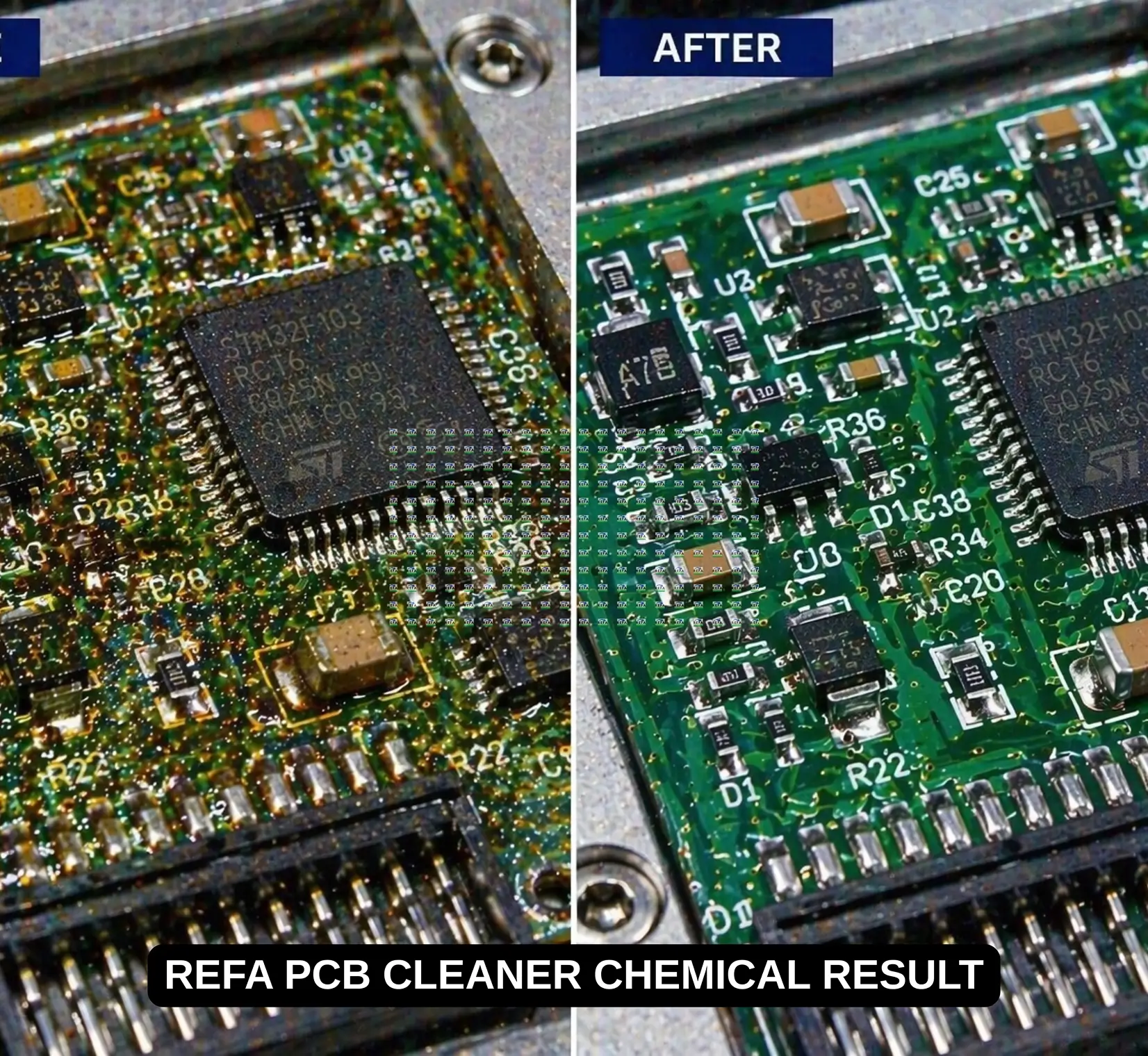
A machined component can look perfectly clean and still fail a cleanliness test.
That’s one of the challenges automotive component manufacturers face every day. A freshly machined aluminium housing may appear spotless, but microscopic metal particles, machining oil, fine dust or residues from previous operations can remain trapped inside cavities, drilled passages and intricate geometries.
These contaminants might seem insignificant. But in automotive manufacturing, where component tolerances, assembly requirements and reliability expectations are increasingly demanding, even small amounts of unwanted residue can create problems.
This is where precision cleaning chemicals for auto parts manufacturers become essential.
Unlike general-purpose degreasers, precision cleaning chemicals are selected and formulated for specific materials, contaminants, cleaning equipment and cleanliness requirements.
What Is Precision Cleaning in Automotive Manufacturing – And Why Visual Cleanliness Is Never Enough?
Precision cleaning is the controlled removal of unwanted contaminants from manufactured components to achieve a defined cleanliness standard.
In the automotive industry, this typically involves removing:
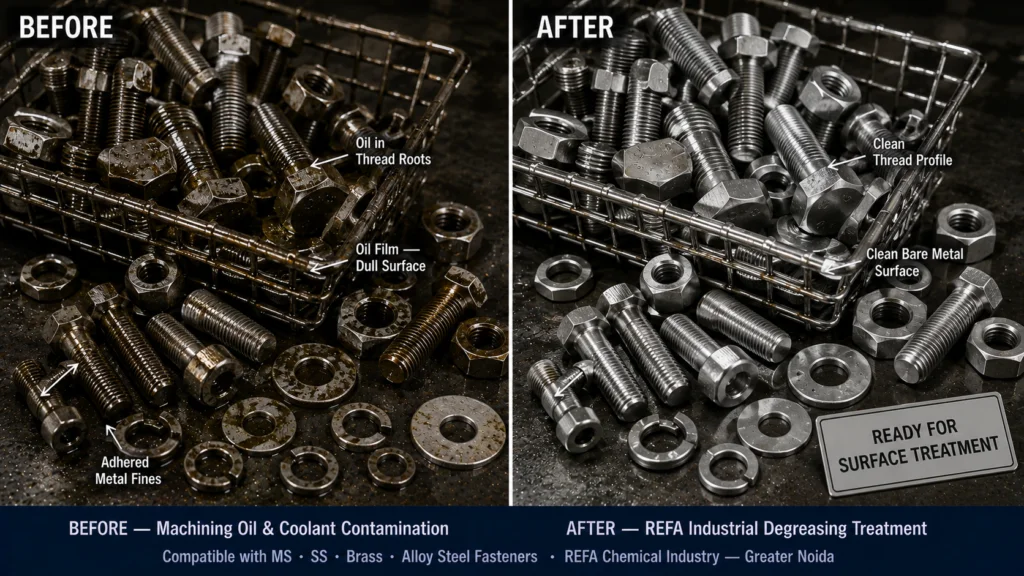
- Machining oils, cutting fluids and lubricants.
- Fine metallic particles, swarf and grinding residues.
- Grease, fingerprints and handling contamination.
- Buffing and polishing compound residues.
- Dust and particulate contamination from manufacturing processes.
- Residues that could interfere with subsequent coating, bonding or assembly.
The objective is not necessarily to remove every trace of every substance. It is to reduce relevant contamination to a level suitable for the component’s intended application.
For instance, an aluminium component being prepared for coating may have different cleanliness requirements from a hydraulic component containing narrow internal passages.
The right cleaning process depends on what the component is made of, what is contaminating it, and what happens to it next.
Why Conventional Degreasing May Not Be Enough
A conventional degreaser may successfully remove visible oil and grease from a component. However, that does not automatically mean the component meets a precision cleanliness requirement.
Consider an aluminium automotive housing after CNC machining.
The component may contain:
- Water-soluble or neat cutting oil.
- Microscopic aluminium particles.
- Residues inside blind holes and threaded areas.
- Contaminants trapped in internal channels.
A chemical that removes oil effectively may still leave particles behind if the cleaning equipment lacks sufficient mechanical action, circulation or rinsing.
Similarly, an aggressive alkaline cleaner may remove contaminants quickly but may not be compatible with a sensitive aluminium alloy or a particular surface finish.
This is why precision cleaning requires the correct combination of chemical formulation, cleaning equipment, operating parameters and contamination control.
Common Automotive Components That Require Precision Cleaning
Precision cleaning is relevant across numerous automotive and auto-component manufacturing processes.
1. Aluminium Die-Cast and Machined Components
Aluminium housings, covers, brackets and die-cast components may require removal of machining oils, fine particles and handling residues.
Cleaning chemistry must be selected with attention to aluminium alloy compatibility, surface appearance and the required level of cleanliness.
2. Automotive HVAC Components
Compressors, condensers, evaporators and related HVAC components may require controlled removal of oils and particulate contamination.
For components with internal passages, cleaning effectiveness depends on more than the chemical alone. Flow, accessibility, filtration, rinsing and drying are equally important.
3. Hydraulic and Precision-Machined Components
Hydraulic components, valve bodies and precision-machined assemblies can be sensitive to residual particles.
Contamination remaining inside a passage or assembly may affect downstream performance.
Cleaning processes are therefore often designed around measurable particle cleanliness requirements.
4. Steel and Cast-Iron Automotive Components
Machined steel and cast-iron components commonly carry cutting fluids, machining residues and particulate contamination.
Alongside cleaning performance, manufacturers may need to consider flash-rust prevention, drying conditions and corrosion protection during storage or transfer.
5. Multi-Metal Assemblies
Some components contain combinations of aluminium, steel, copper, brass or other materials.
These applications require particular attention to chemical compatibility because a formulation suitable for one metal may adversely affect another.
Which Precision Cleaning Methods Are Used in Automotive Manufacturing?
There is no single cleaning method suitable for every automotive component.
Ultrasonic Cleaning
Ultrasonic cleaning uses high-frequency sound waves in a liquid bath to create cavitation, helping dislodge contamination from accessible surfaces and intricate geometries.
It can be useful for precision-machined components, small parts and complex shapes.
However, ultrasonic cleaning performance depends on frequency, power distribution, part positioning, chemistry, temperature and cleaning time.
Spray Cleaning
Spray cleaning combines chemical action with directed liquid impingement.
It is commonly considered for production lines requiring repeatable cleaning of components with accessible surfaces.
Spray pressure, nozzle positioning, flow rate, chemical concentration and bath maintenance all influence performance.
Immersion Cleaning
Immersion cleaning involves submerging components in a chemical solution, often with agitation or circulation.
It may be suitable for batch cleaning operations, although the required cleaning performance must be validated for the component geometry and contaminants.
Multi-Stage Cleaning Systems
Some automotive manufacturing operations require several stages, such as:
Pre-cleaning → Main cleaning → Rinsing → Final rinsing → Drying → Cleanliness inspection
The exact sequence depends on the application. A precision-cleaning process may also include filtration, oil separation, controlled water quality and measures to prevent recontamination.
What Makes a Good Precision Cleaning Chemical?
The strongest cleaning chemical is not necessarily the best cleaning chemical.
A suitable precision cleaning formulation should deliver consistent cleaning while remaining compatible with the component, equipment and downstream process.
Manufacturers should evaluate several factors.
Contaminant removal: Can the chemical remove the actual machining oil, grease or process residue present on the component?
Material compatibility: Does it clean the substrate without unacceptable staining, etching, corrosion or changes to the required surface finish?
Equipment compatibility: Is the chemistry appropriate for ultrasonic, spray, immersion or another cleaning method?
Rinsability: Can residual cleaning chemistry be adequately removed when the process requires it?
Bath performance: How does cleaning effectiveness change as the bath accumulates oils, particles and dissolved contaminants?
Process economics: What is the actual cost per successfully cleaned component, rather than simply the purchase price per kilogram of chemical?
Safety and operational requirements: What controls are needed for handling, storage, wastewater treatment and worker exposure?
A chemical that performs well during a short laboratory demonstration must still be evaluated under actual production conditions.
Understanding Millipore Testing and Technical Cleanliness
In automotive component manufacturing, visual inspection alone may not be sufficient to verify cleanliness.
Some manufacturers use membrane filtration-based cleanliness testing, commonly referred to in industry as Millipore testing, to collect and evaluate residual particles extracted from components.
Depending on the customer’s specification, testing may assess particle counts, size distributions, mass or particular contaminant types.
Standards such as ISO 16232 and VDA 19.1 provide recognised frameworks for technical cleanliness assessment in automotive applications.
However, these standards should not be confused with one universal cleanliness limit. Acceptance criteria are generally established for the specific component and its intended function.
An important point is that cleaning chemicals and cleaning machines work together.
A chemical may dissolve oil effectively, but removing solid particles also depends on factors such as fluid movement, filtration, part geometry and the cleaning process itself.
If a component repeatedly fails its cleanliness test, increasing chemical concentration is not automatically the solution.
The root cause could involve inadequate rinsing, contaminated baths, insufficient filtration, poor spray coverage, inaccessible cavities or recontamination after cleaning.
Why Cleaning Chemistry Must Be Matched to the Metal
Different metals respond differently to cleaning formulations.
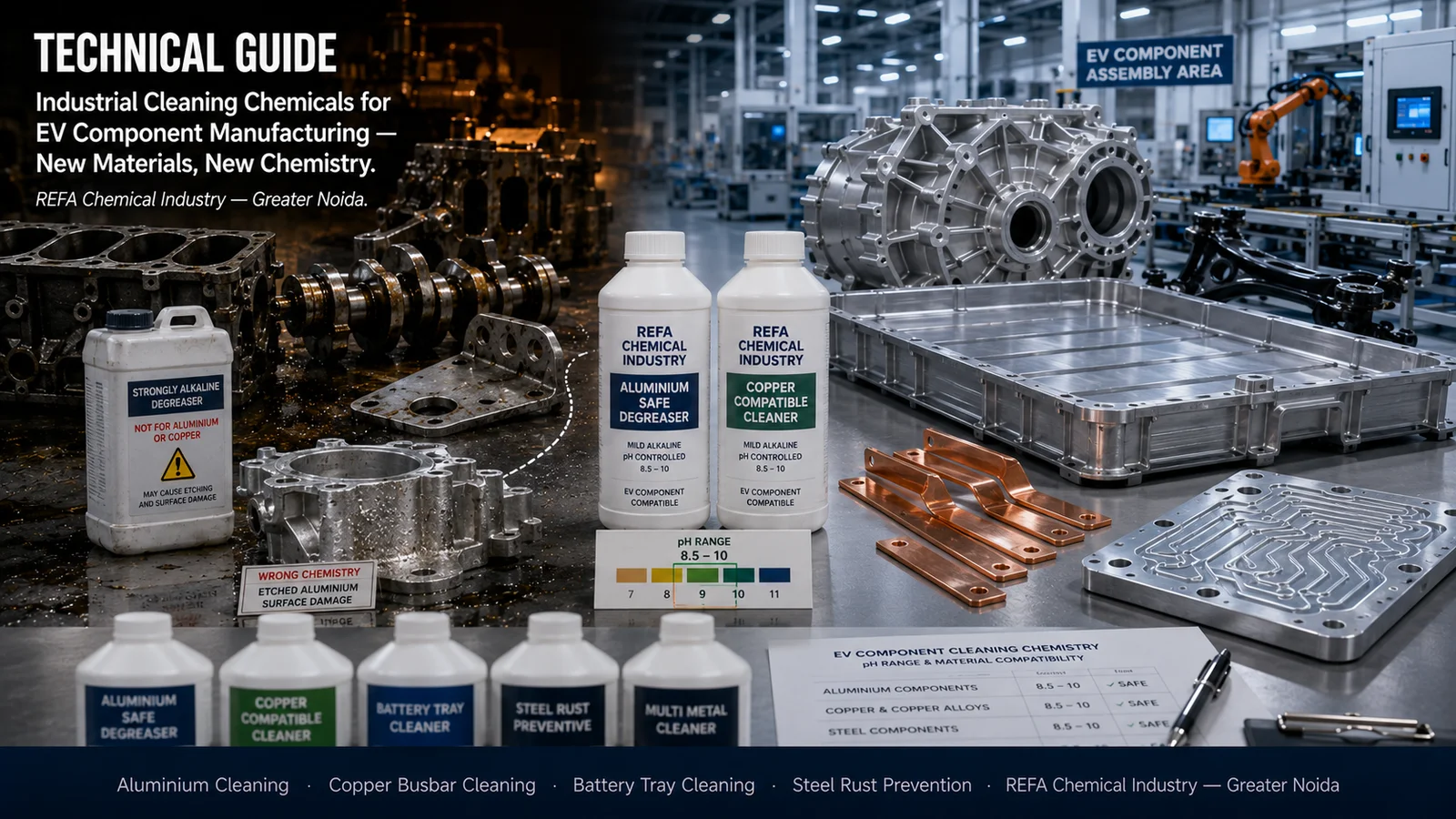
For example, a highly alkaline formulation may be appropriate for some ferrous-metal cleaning applications but unsuitable for certain aluminium alloys or sensitive finishes.
Similarly, copper and brass components may require formulations designed to minimise undesirable surface discolouration.
For mixed-metal components, chemical compatibility becomes even more important.
This is why automotive manufacturers should avoid selecting cleaning chemicals based solely on a generic product description such as “heavy-duty degreaser.”
The correct starting point is an understanding of the substrate, contamination, cleaning process and required result.
Five Common Mistakes in Automotive Precision Cleaning
1. Selecting Chemicals Based Only on Price
A lower-priced chemical is not necessarily more economical.
Concentration, bath life, rejection rates, cleaning time and rework costs all influence the true process cost.
2. Increasing Concentration Without Investigating the Problem
When cleaning performance deteriorates, operators may increase chemical dosing.
But if the actual problem is excessive bath contamination, blocked nozzles or inadequate filtration, additional chemical may provide little benefit.
3. Ignoring Rinsing and Drying
A component may be free of machining oil but still retain cleaner residue or water marks.
For certain applications, rinsing and drying are critical stages of the cleaning process.
4. Using the Same Cleaner for Every Metal
Aluminium, cast iron, stainless steel, copper and brass can have different chemical compatibility requirements.
A cleaner suitable for one material may not be suitable for another.
5. Treating Visual Cleanliness as Final Proof
A bright, oil-free surface is not necessarily free from fine particulate contamination.
Where technical cleanliness is specified, the process should be validated using the appropriate inspection or testing method.
How REFA Supports Precision Cleaning Applications
At REFA Chemical Industries Pvt. Ltd., we manufacture industrial metal cleaning, degreasing and surface preparation chemicals for automotive component manufacturers and allied engineering industries.
Our industrial cleaning portfolio includes water-based chemical solutions for aluminium, mild steel, cast iron, stainless steel, copper, brass and multi-metal cleaning applications.
We work with manufacturers to understand their component material, existing contamination, cleaning equipment and process requirements before recommending an appropriate chemical solution.
Our application areas include:
- Post-machining cleaning and degreasing.
- Aluminium and aluminium-alloy component cleaning.
- Ultrasonic and spray cleaning applications.
- Cleaning before surface treatment, coating or assembly.
- Removal of machining oils, grease and process residues.
- Application-specific industrial cleaning requirements.
Where customers have defined technical cleanliness requirements, chemical selection and trial evaluation can be coordinated around those objectives, with final performance subject to validation under actual process conditions.
Choosing the Right Precision Cleaning Chemical: Start With the Application
Before approaching a chemical supplier, automotive component manufacturers should ideally have answers to a few practical questions.
What is the component material? Is it aluminium, steel, cast iron or a combination of metals?
What contamination needs to be removed? Is it cutting oil, machining grease, metallic particles or another process residue?
What cleaning machine is available? Is it an ultrasonic tank, spray washer, immersion system or multi-stage cleaning line?
What happens after cleaning? Will the component undergo coating, assembly, storage or further machining?
And most importantly, how will the cleaning result be evaluated?
These answers provide a much stronger foundation for chemical selection than choosing a cleaner solely by its advertised strength or concentration.
Frequently Asked Questions
What are precision cleaning chemicals for auto parts manufacturers?
Precision cleaning chemicals are specialised formulations used to remove manufacturing contaminants from automotive components under controlled cleaning conditions. They are selected according to the component material, contaminant type, equipment and required cleanliness level.
What is the difference between precision cleaning and regular degreasing?
Regular degreasing primarily focuses on removing oils and grease. Precision cleaning considers the broader cleanliness requirement, which may include particulate contamination, chemical residues and the suitability of the component for subsequent manufacturing operations.
Which cleaning chemicals are suitable for aluminium automotive components?
The appropriate chemical depends on the aluminium alloy, contamination, cleaning method and required surface condition. Aluminium-compatible formulations should be evaluated through controlled trials rather than selected solely on the basis of alkalinity or cleaning strength.
Can water-based chemicals be used for automotive precision cleaning?
Yes. Water-based cleaning chemicals are used in many automotive component cleaning applications, including ultrasonic, spray and immersion processes. Their suitability depends on the specific cleanliness requirement, component material, equipment and validated process.
Can a precision cleaning chemical help meet Millipore cleanliness requirements?
An appropriate chemical can contribute to a successful technical cleanliness process by removing oils and other relevant residues. However, particle cleanliness also depends on cleaning equipment, mechanical action, filtration, rinsing, drying and contamination control. Compliance must be demonstrated through suitable testing.
What is the best cleaning method for machined automotive components?
There is no universally best method. Ultrasonic, spray, immersion and multi-stage systems each have advantages and limitations. Selection should be based on component geometry, contamination, production volume and cleanliness specifications.
Does REFA manufacture precision cleaning chemicals for automotive component manufacturers?
Yes. REFA Chemical Industries Pvt. Ltd. manufactures industrial metal cleaning and degreasing chemicals for automotive and engineering manufacturing applications, including chemical solutions intended for ultrasonic, spray and other application-specific cleaning processes.
Looking for a Precision Cleaning Chemical for Your Automotive Components?
If your manufacturing process involves persistent machining oil, grease, component contamination or cleaning challenges, REFA can help evaluate suitable water-based cleaning chemistry for your application.
Share your component material, contamination type, cleaning process and required cleanliness specifications with our technical team.
REFA Chemical Industries Pvt. Ltd.
Greater Noida, Uttar Pradesh, India
Website: https://refachemical.com/
Email: info@refachemical.com
Request a technical consultation, product sample or application-specific cleaning recommendation.